Key Takeaways
- A hydrogen colour is not a tax qualification or a bankable business model.
- Keep production credits, capital credits, auction premiums and industrial-policy targets separate.
- Use realized support after qualification, monetization, verification and timing constraints.
- Test full eligible support, a 50% haircut and the post-expiry margin on one consistent boundary.
- End with a decision: advance, redesign or relocate, wait, or stop—and name the input that changes it.
Start with year eleven, not the largest subsidy
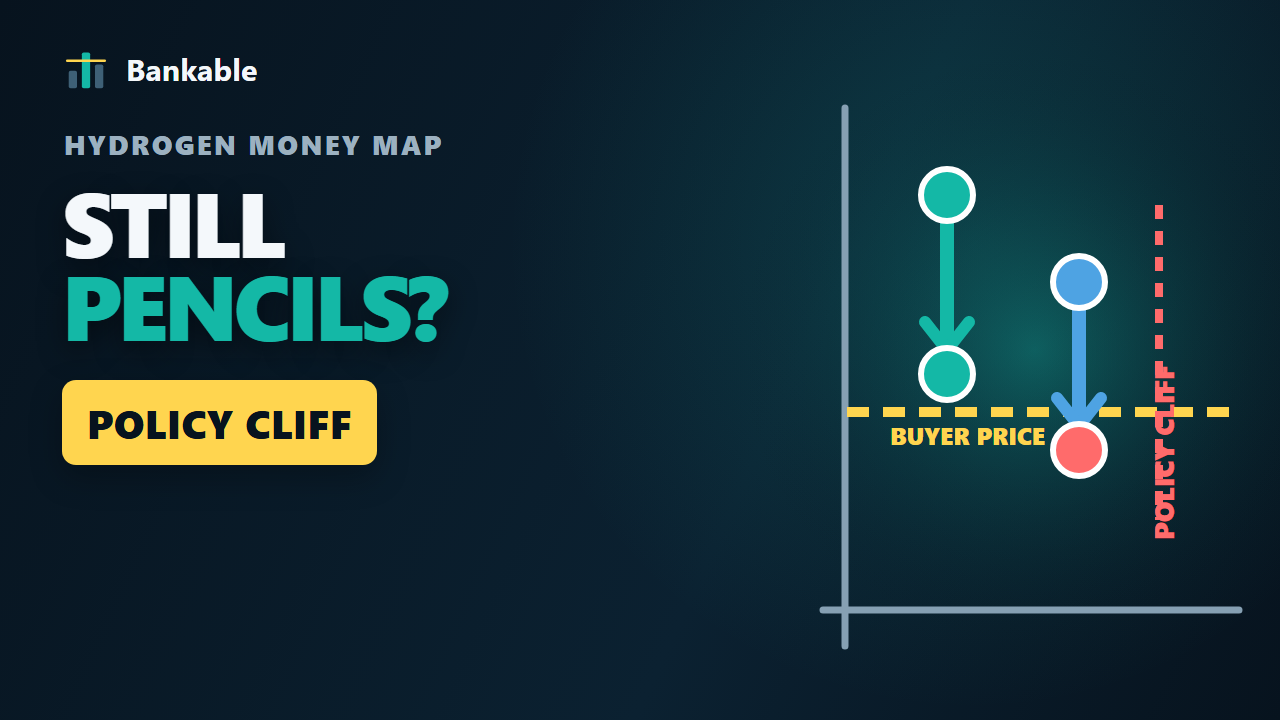
A hydrogen project shows a profit for ten years. In year eleven, the production support ends and the margin disappears. The equipment has not changed. Neither has the customer. What looked like an industrial advantage was partly a policy advantage with an expiry date.
That does not make the project worthless. It changes what must be financed, contracted and stress-tested. A developer needs to know which part of the margin comes from engineering, which comes from the buyer, and which depends on a rule, an award or a tax position. A lender also needs to know whether those cash flows last as long as the debt.
No hydrogen colour wins everywhere. The useful question is whether this project, in this market, survives less support than the pitch deck assumes.
The money map therefore begins with delivered cost before support and the price a real buyer will pay. The comparison then adds only support the project can qualify for and monetize. It finishes with two uncomfortable tests: cut that value in half, then remove expiring support altogether.
Four kinds of policy, four different accounting problems
A production credit, a capital credit, an auction premium and an industrial-policy target are not interchangeable. Their headline numbers have different units and different recipients. Putting them in one subsidy league table hides the conditions that determine the money.
| Instrument | Keep this unit first | Question before adding value |
|---|---|---|
| U.S. 45V | Tax credit per kg | Does the facility meet the lifecycle, timing and verification conditions? |
| U.S. 45Q | Tax credit per tonne of qualifying CO₂ | Which capture boundary, disposition route and credit treatment apply? |
| Canada Clean Hydrogen ITC | Percentage of eligible capital | What is the eligible cost, CI tier and available-for-use year? |
| EU auction support | Contract premium per verified kg | Is there an award and signed agreement, not merely eligibility? |
| China integrated-application pilot | City-cluster performance reward | What reaches this project after selection, allocation and verification? |
Only after preserving those boundaries should the model convert value to a common production basis. Keep currencies, price years, delivery scope and annual output explicit. A lower plant-gate cost is not necessarily a lower delivered cost, and an attractive credit does not remove compression, storage, transport or customer-credit risk.
United States: the amount is only one gate
The IRS's 2026 45V amounts before the increased-credit treatment are $0.131, $0.164, $0.219 and $0.656 per kilogram across the four lifecycle-emissions bands. The top band is strictly below 0.45 kg CO₂e per kg hydrogen. The five-times treatment is conditional; the resulting $3.28/kg maximum is not a universal base case. IRS Notice 2026-41 supplies the year-specific amounts; the final rules supply the qualification framework.
The construction clock matters separately: Public Law 119-21 requires construction to begin before 2028 for the facility to qualify. A favourable steady-state model cannot rescue a project that misses a load-bearing deadline.
For captured-carbon cases, keep 45Q in dollars per tonne until the qualifying captured-and-disposed tonnes per kilogram of hydrogen are established. Placement date, disposition, labour treatment, ownership and recapture matter. The Form 8933 instructions and actual facility boundary should govern the comparison, not the shorthand that one colour always gets one credit. California's LCFS belongs in a separate, qualifying-pathway scenario—not every U.S. hydrogen base case.
Canada: annualize the capital benefit
Canada's Clean Hydrogen ITC reduces eligible capital exposure rather than paying a fixed amount on each kilogram. Regular rates are 40%, 25% or 15% across the qualifying CI tiers; they halve for property available for use in 2034 and end afterward. Labour and property conditions still apply. The CRA rate table is the starting point, not the complete project answer.
For screening, annualize the eligible capital benefit over a stated financing basis and divide by production on the same boundary. If output falls, that conversion changes. Keep expected CI separate from verified operating performance: NRCan's validation and verification guidance makes the distinction important. A case balanced on a tier boundary needs a downside scenario, not more decimal places.
Europe: classification is not an award, and a border charge is not a cheque
RFNBO qualification under the renewable-electricity sourcing rules is distinct from the low-carbon-fuels methodology. Neither should be mistaken for a guaranteed auction payment.
The Commission's IF25 results show selected projects invited to grant-agreement preparation. Cloudberry's €0.44/kg bid is a premium tied to that project and process—not its hydrogen selling price or proof of its pre-support cost. Keep selected, signed, operating and paid as different states.
CBAM is an import carbon-cost mechanism. It can change a buyer's alternatives without paying the producer an equivalent cash amount. The amended small-importer exemption does not cover hydrogen or electricity. Any commercial advantage must be demonstrated through the actual product, emissions boundary and buyer contract. The amended regulation preserves that distinction.
China: model the local delivery system, not an invented national credit
China's 2026 integrated-application pilot is structured around city clusters, industrial uses and performance-based rewards. Its 2030 end-use price objectives—below RMB 25/kg on average and around RMB 15/kg in advantaged areas—are targets, not current transaction prices. An award to a city cluster is not automatically a payment to a particular hydrogen plant. The three-ministry notice sets out the selection and performance conditions.
For an unselected or unverified case, the calculator's central-support base case stays at zero. That does not mean industrial policy has no value. Equipment cost, infrastructure, regional energy resources and nearby industrial demand may matter greatly. It means those advantages must be shown in the project's cost and buyer assumptions, rather than compressed into a fictional national per-kilogram credit.
What the public projects do—and do not—prove
Cloudberry provides a selected bid. Nine Mile Point provides an operating nuclear-hydrogen demonstration and captive use. Kuqa provides design-scale and refinery-integration evidence. The Edmonton project record provides a dated scope and support context.
Those are useful anchors, but the reviewed disclosures do not combine pre-support cost, actual lifecycle CI, realized support, contracted price, output and post-support economics on one consistent boundary. Do not fill the missing cells by mixing an old capital estimate with a later expanded capacity figure. Missing economics remain missing.
The same three tests for every pathway
Renewable electrolysis must carry power price and utilization. Gas plus capture must carry methane and the complete storage chain. Pyrolysis must survive a realistic carbon-product market. Geological hydrogen still needs commercial flow, recovery and delivery evidence. Nuclear hydrogen must compete with the value of selling the same electricity. The incumbent also needs its applicable carbon and compliance costs.
- Full eligible support: turn on only benefits supported by the case's qualification and monetization assumptions.
- 50% haircut: ask whether margin survives materially less realized policy value. This is a sensitivity, not a prediction that legislation will be halved.
- Policy cliff: remove expiring support and use the post-expiry buyer price and cost. Also compare support duration with financing tenor.
A profitable supported year is not the same as a financeable project life.
The four actions are advance when the economics are resilient, redesign or relocate when support masks an addressable weakness, wait when qualification or timing is unresolved, and stop when even the eligible case does not close. The useful output is not just a label. It is the one assumption that would change the decision.
Run your project's policy-cliff test
The free nine-sheet Hydrogen Policy Resilience Calculator separates project inputs, U.S., Canadian, EU and Chinese modules, resilience scenarios, the money map and sources. Blue-text cells are editable. Defaults are illustrative screening cases, not disclosed project bids or eligibility advice.
Get the calculator and guide →Episode/workbook source baseline: August 22, 2026. Key U.S. amount, Canadian rate, EU auction and Chinese pilot pages rechecked August 25, 2026. Rules and project status can change; recheck the linked primary sources before relying on a case. Technology, policy and project-economics commentary only—not legal, tax, accounting, lending or investment advice.